


Poodle Temperament Explained: What They're Really Like

Updated: 2 days ago
By Nick, co-founder of Doggy Styles Inc and owner of Bruno, a rescued French Bulldog. Last updated 14 October 2026.
Quick Answer
Poodles are clever, affectionate, alert and sensitive, with a clownish streak that never quite grows up. They were bred as working water retrievers, so they're built to watch people closely and work with them, which is why a Poodle feels less like a pet and more like a very observant colleague who happens to love you.
Key takeaways
The Poodle's temperament comes from a working past, not a show ring: athletic, quick and tuned into people.
Breed tilts the odds, but a 2022 study of 18,000 dogs found breed explains only about 9% of differences in behaviour.
Calm, consistent handling brings out the best in them. Chaos and harsh correction bring out the worst.

If you're still understanding the breed properly, start here:
👉 POODLE GUIDE — Full Behaviour, Personality & Ownership Breakdown
What's a Poodle really like? What people get wrong
Most people's picture of a Poodle comes from the show ring: the pom-poms, the pedestal, the faint air of a dog that has opinions about cutlery. So they expect something delicate, a bit precious, and very possibly yappy.
Then they meet one. The owner of Mimikyu, a Toy Poodle, had spent decades with big dogs and expected exactly that stereotype. What they found instead, as they told Purina, was a dog that was "adaptable, funny, intelligent, loves everyone", and "not a yappy ankle biter" after all.
The owner of Skylar, a Standard Poodle, put it even more simply: "She is supremely confident and a real clown." That's the Poodle most owners end up living with. Not fragile. Not precious. Just very, very aware.
The official description agrees. The Kennel Club's breed standard sums up the Poodle's temperament in four words: "gay-spirited and good-tempered". Nothing about precious. Nothing about fragile.
The first week
Day two. She doesn't explore the house the way you expected. She explores you. Where you sit, which door you use, what you do before you put the kettle on. By day five she's waiting at the kitchen door before you've stood up. You haven't taught her anything yet. She's been taking notes.
Poodle temperament at a glance
Trait | What it looks like at home | What it means for you |
Clever | Learns routines, rules and loopholes fast | Needs a bit of brainwork every day |
People-focused | Wants to be in the room you're in | Not a dog to leave out of family life |
Alert | Notices every sound, car and visitor | May want to tell you about all of them |
Sensitive | Reacts to tone, tension and raised voices | Gentle, consistent handling works best |
Playful | Games, clowning and the odd zoomie | Fun well into old age |
Owners recognise all of it. The head tilt when you say something interesting. The way a Poodle watches a visitor before deciding what to make of them. The sudden burst of silliness from a dog that was, two minutes ago, the most dignified creature in the room.
That mix of brains and daftness is what Doggy Styles Inc designs around: clean, minimal Poodle pieces for the people who live with it.
👉 Shop Poodle women's t-shirts, unisex t-shirts and sweatshirts and hoodies
👉 or explore the full POODLE COLLECTION

Why are Poodles like this?
Bred to work beside a hunter
The Poodle wasn't designed to sit on a cushion. The American Kennel Club traces the breed to Germany, where it was a water retriever, built to work in cold water alongside a hunter, watching where the birds fell and taking direction at a distance. Almost everything owners love, and struggle with, in the Poodle temperament starts there.
A dog bred for that job has to be athletic, brave, quick to learn and permanently tuned in to the person it works with. Take away the marsh and the ducks, and you're left with a dog that applies all of that to your kitchen.
Clever enough to read the room
Poodles came second of 130 breeds in psychologist Stanley Coren's ranking of working intelligence, built on a survey of obedience judges (Coren, 1994). But the cleverness owners notice most isn't tricks. It's people-reading.
Poodles watch people closely, and they're good at it. They notice where you look, what you pick up and how you move, and they act on it. In a Poodle, that adds up to a dog that seems to know you're going out before you've found your keys, and can read a tense room from the doorway.
What the research says
Breed isn't destiny. A 2022 study in Science, led by Kathleen Morrill and Elinor Karlsson, combined owner surveys of more than 18,000 dogs with DNA from over 2,000 of them. Breed explained only about 9% of the variation in behaviour between individual dogs (Morrill and colleagues, 2022). So breed tilts the odds. Your own Poodle's upbringing tilts them far more.
There's one tendency worth knowing about, though. In a large owner survey of breed differences in aggression, Poodles were among the breeds rated higher for aggression towards strangers, mostly growling and snapping rather than serious bites, while aggression towards their own owners was rare (Duffy and colleagues, 2008). The authors stressed that dogs varied enormously within every breed. In practice it fits what owners describe: a dog that adores its own people and reserves judgement on everyone else.
That sensitivity to people deserves a post of its own, and it has one.
👉 WHY ARE POODLES SO SENSITIVE? — Moods, Tone & Why They Feel Everything
How temperament gets shaped
A Poodle puppy arrives with the raw materials: brains, energy, attentiveness. What it does with them is decided in the first year, mostly by things that don't feel like training at all.
Every visitor who's calm teaches it visitors are fine. Every hoover that gets switched on without fuss teaches it hoovers are boring. Every time a whine at the back door gets it opened, it learns that too. A clever dog learns fast, and it doesn't distinguish between the lessons you meant and the ones you didn't.
The hoover
Week eight. You switch on the hoover and she shoots under the table, ears flat, eyes huge. You switch it off, sit on the floor and let her come to you. The next day you leave it standing in the hall, silent, with a biscuit on top. By the end of the week she walks past it like it's furniture. By the end of the month she's supervising.
Most of the training that shapes a Poodle's temperament happens in exactly these small moments, which is why it's worth knowing how they learn.
👉 ARE POODLES EASY TO TRAIN? — What Actually Works

Living with a Poodle's temperament
Day to day, it's mostly lovely. Owners talk about affection first. Ted's owner, asked by Purina what they loved most about their Standard Poodle, said simply: "He loves cuddles and is very affectionate." The biggest challenge? "Barking at strangers." Which is the Poodle temperament in two lines: devoted to its people, and keen to report on everyone else.
Breeders see the same thing from puppyhood. Steven Zonis picked Rudy, now an award-winning therapy dog, from his litter at four weeks old because, in his words, "he was Mr. Personality and got our attention" (AKC).
A Poodle probably isn't the right temperament for you if:
you want a dog that's happy being left out of family life
your home is loud and unpredictable most of the time
you'd rather a dog that doesn't notice, or comment on, visitors
you don't fancy giving a clever dog something to think about every day
The visitor test
A friend comes round for the first time. She doesn't rush to the door. She stands back in the hallway, watching how you greet them. Once you've laughed and hugged, she walks over, sniffs politely and takes her cue from you for the rest of the evening. She didn't decide what she thought of your friend. She waited to see what you thought.
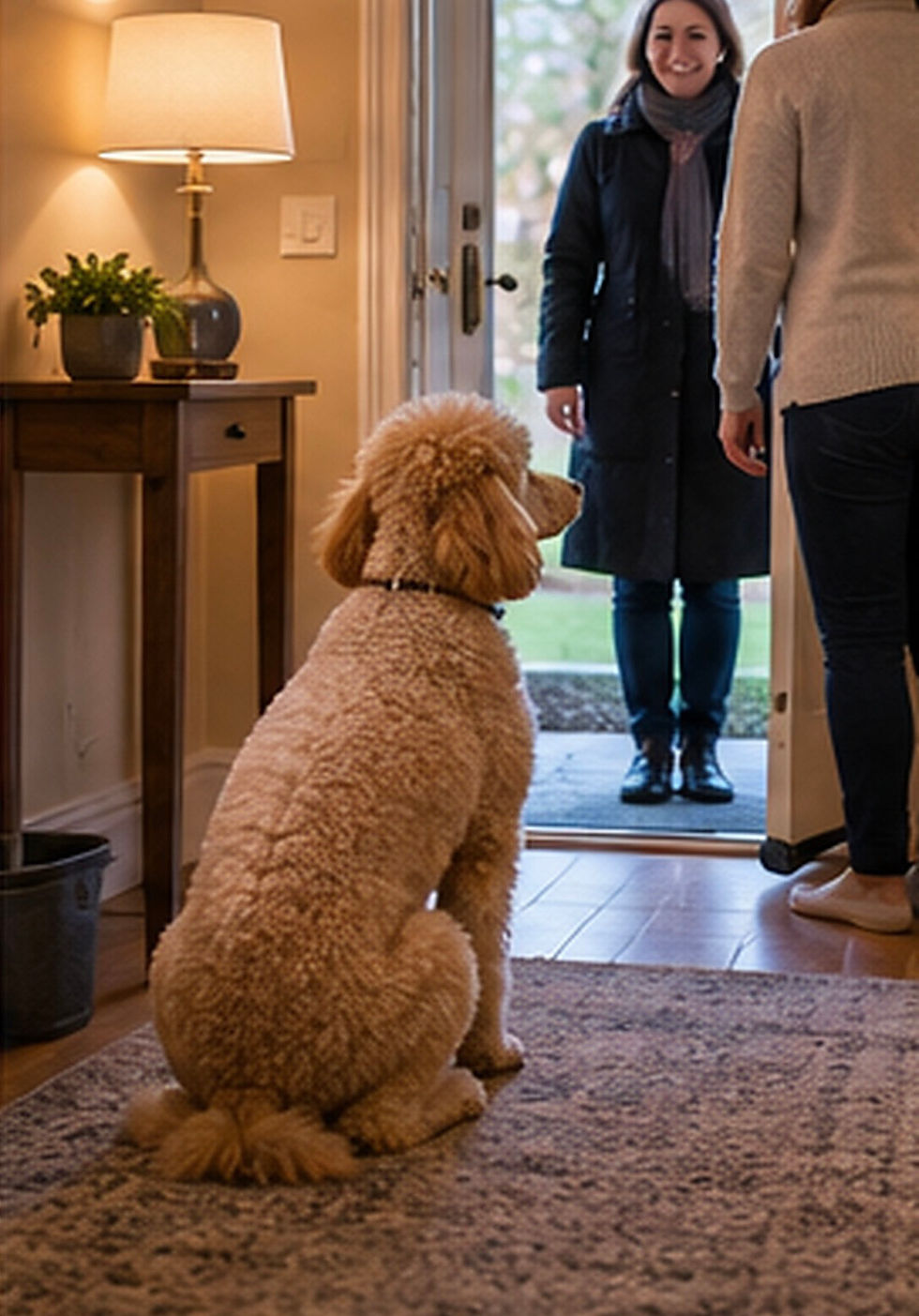
That watchfulness is also why Poodles can be noisy at the window, which is a subject of its own.
👉 DO POODLES BARK A LOT? — Alert Barking, Habits & What Helps
What happens over months
Most Poodles go through a teenage phase somewhere between about six months and two years. Recall that was perfect suddenly isn't. Rules that were settled get tested again. It's not a change of personality. It's a clever adolescent checking whether the rules still apply.
How you respond matters more than usual here, because Poodles are sensitive. Research on training methods has found that dogs trained mainly with punishment show more signs of stress, during training and beyond it. With a dog this tuned in to you, harshness doesn't produce obedience. It produces worry.
The other thing that can grow over months is dependence. A Poodle that's never apart from its person can find being alone very hard.
The adolescent
At five months she was an angel: sat on cue, walked beautifully, came when called. At nine months she looks at you, considers your request, and goes to sniff a lamppost instead. You try again. She sits, eventually, with the air of someone doing you a personal favour. You start counting down to her second birthday.
If your Poodle struggles when you leave, that's worth reading about next.
👉 DO POODLES GET SEPARATION ANXIETY? — Signs, Causes & How to Help
How to bring out the best in a Poodle's temperament
In the moment
Keep your voice level. A calm 'no thanks' does more than a raised one.
Reward the behaviour you want the second it happens, especially calm around visitors.
When they're unsure of someone, let them watch from a distance rather than pushing a greeting.
Long term
Socialise early and gently: people, children, traffic, other dogs, and household noises.
Give ten minutes of brainwork a day, such as training, puzzle feeders or scent games.
Keep routines predictable: meals, walks and bedtime at roughly the same times.
Practise short spells apart, so being alone is normal rather than an event.
The quiet hello
Six months in, the doorbell goes. She lifts her head, looks at you, and waits. You get up, say a calm hello to the delivery driver, close the door. She's already lying back down. Nobody barked. Nobody shouted. It's the least dramatic thing that's happened all day, and it took half a year to get there.
When to get help: if your Poodle seems fearful most of the time, reacts badly to people or dogs, or has suddenly changed in temperament, talk to your vet first. They can rule out pain or illness and refer you to a qualified behaviourist.
Is a Poodle's temperament different from other breeds?
Compared with a Labrador, a Poodle is just as affectionate but more watchful. Labs tend to greet strangers as long-lost friends. Poodles prefer to be introduced. Compared with a Border Collie, a Poodle is less driven by work and more interested in people; a Collie's mind is on the sheep, a Poodle's is on you. Compared with smaller companion breeds, Miniature and Standard Poodles are sturdier, sportier and far more up for a long walk.
Toy, Miniature or Standard?
The three sizes share one breed standard and broadly one temperament. What changes is the practical side of living with them.
Size | Height at the shoulder (Kennel Club) | Temperament notes | Usually suits |
Toy | Under 28cm | Often the most vocal; can be wary of strangers | Calmer homes, older children |
Miniature | 28cm to 38cm | Lively, sociable, very adaptable | Most homes, including flats |
Standard | Over 38cm | Often the most laid-back indoors; athletic outside | Active families, younger children |
These are tendencies, not rules. Many owners find Toys a little more vocal and Standards a little more relaxed, but individual dogs vary far more than sizes do. Remember the 9% figure.
If you're weighing up how that temperament fits a household, that's the next thing to read.
👉 ARE POODLES GOOD FAMILY DOGS? — Children, Size & Daily Life
What owners realise over time
After a year or so, most owners stop describing their Poodle as 'clever' or 'sensitive' and start describing it as a person. It has moods, preferences, jokes and opinions about the neighbours. The work of the first year, the calm hellos and the patient adolescence, pays off as a dog that's relaxed precisely because it understands the house it lives in.
Same hallway, a year on
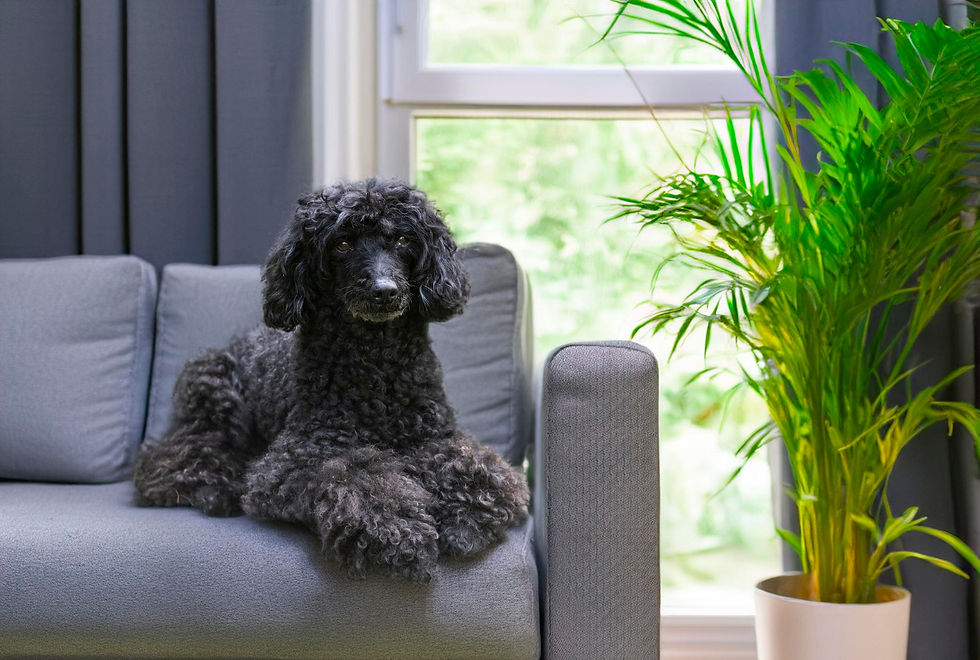
The same hallway as that first week. The key turns in the door and she's there, but not frantic. She wags, leans against your legs, follows you to the kitchen and sits by the door you always use, exactly where she sat on day five. Nothing about her has changed. She's just stopped having to work you out.
The verdict
What's a Poodle's temperament really like? Clever, affectionate, alert and sensitive, with a sense of humour that never grows up. It comes from a working past: a dog bred to watch a person closely and work alongside them. They adore their own people and like to be introduced to everyone else.
Give them calm, kind handling, some daily brainwork and a predictable home, and you'll have one of the most rewarding companions in the dog world. Expect an ornamental lapdog and you'll be very surprised.
If you're still getting to know the breed, the guide covers the full picture.
Living with a Poodle means being watched, consulted and occasionally outwitted by your own dog. The Poodle range is for people who wouldn't have it any other way.
👉 Explore Poodle women's t-shirts, unisex t-shirts and sweatshirts and hoodies
👉 or explore the full POODLE COLLECTION
Got a Poodle with more personality than the rest of the house put together? Show us. Tag @doggystylesinc on Instagram or find us on Facebook at Doggy Styles Inc, and your Poodle could feature in a future post.
Continue Understanding the Poodle Breed
FAQs
What is a Poodle's temperament like?
Clever, affectionate, alert and sensitive, with a playful, clownish streak. The Kennel Club's breed standard calls them "gay-spirited and good-tempered". Most are devoted to their own family and polite but reserved with people they don't know yet.
Are Poodles calm dogs?
Adult Poodles are often calm indoors, especially in a predictable home with enough exercise and brainwork. They stay alert, though, and young Poodles can be lively and bouncy until they're two or three.
At what age do Poodles calm down?
Most settle noticeably between two and three years old, after the adolescent phase that runs from roughly six months to two years. Consistent training, daily mental exercise and a steady routine make the change come sooner.
When do Toy and Miniature Poodles calm down?
Usually around the same age as Standards, somewhere between two and three. Smaller Poodles can stay more vocal and excitable for longer, so calm, consistent responses to barking and jumping help a lot.
Are Poodles friendly?
With their own people, very. With strangers, most are friendly but reserved, preferring to watch and be introduced rather than rush in. Early socialisation makes a big difference.
Are Poodles aggressive?
Not typically. Research found Poodles were among the breeds more likely to be wary of strangers, mostly growling or snapping, while aggression towards their own owners was rare. Good socialisation and kind handling keep that wariness in check.
Are Poodles anxious or nervous dogs?
They aren't naturally nervous, but they are sensitive. In a loud or unpredictable home, or with harsh handling, that sensitivity can turn into anxiety. Calm routines and reward-based training help prevent it.
What is a Standard Poodle's temperament like?
Standards are athletic, playful and often the most laid-back of the three sizes indoors. They need plenty of exercise and brainwork, and tend to suit active families well.
What is a Miniature Poodle's temperament like?
Lively, sociable and very adaptable. Miniatures fit into most homes, including flats, and many owners find them a little more vocal than Standards, so early training around barking helps.
Do Poodles need mental stimulation?
Yes. A Poodle's brain needs exercise as much as its legs do. Ten minutes a day of training, scent games or puzzle feeders makes a noticeably calmer dog.


Comments