


Why Do Labradors Follow You Everywhere? 6 Real Reasons

Updated: 1 day ago
By Nick, co-founder of Doggy Styles Inc and owner of Bruno, a rescued French Bulldog. Last updated 15 October 2026.
Quick Answer
Labradors follow you everywhere because they were bred to watch a person and work with them, and that starts remarkably early: research on Labrador and Golden Retriever puppies found they were following human pointing gestures at eight weeks old. Add a deep interest in food, a fondness for routine and a strong dislike of missing anything, and you have a dog who treats every trip to the kitchen as a meeting he should attend. It's normal. It only needs attention if your Lab can't settle when he can't see you.
Key takeaways
Labradors are born watching people. Following you is the adult version of that.
Food, routine and curiosity explain most of the shadowing, especially around the kitchen.
Teaching a 'wait' at doors and a mat to go to while you cook gives the shadow somewhere useful to be.

If you're still getting to know the breed, start here:
👉 LABRADOR GUIDE — Full Behaviour, Personality & Ownership Breakdown
Why do Labradors follow you everywhere? What people get wrong
The usual assumption is that a dog who follows you is anxious. With most Labradors, it's closer to the opposite. He's interested, he's involved and he's checking whether whatever you're about to do might concern him. It usually does, in his view.
Owners tend to say it plainly. Retrieve's owner, on Purina's owner stories, describes a rescued Lab who "adores me and follows me everywhere", and adds that she's "Very devoted to the one who took her in." Jess's owner, also on Purina, explains how they ended up together: "I didn't pick her - she picked me and my husband." Labradors are not shy about choosing.
A note on the stories in this post: the dated moments (week one, month two and so on) are illustrative scenes based on common Labrador owner experiences, not the story of one real dog. The owner quotes are real, and link to where they were published.
The escort
Week one. You get up to fetch a glass of water. He gets up too. You go to the kitchen. He comes to the kitchen. You come back and sit down. He comes back and lies down, with a small groan, as if the whole expedition was rather tiring for both of you. It happens eleven more times before bed. You've stopped counting by Wednesday.
Following, shadowing or worrying? A quick guide
What he does | What's usually behind it | Anything to do? |
Gets up whenever you get up | Curiosity and not wanting to miss out | No |
Arrives in the kitchen before you do | Food, and a good memory for routine | Give him a mat to wait on |
Waits outside the bathroom | Keeping track of his person | No, unless he's distressed |
Follows one person more than anyone | That's who feeds, walks and plays most | Share the jobs around |
Can't settle at all when you're out of sight | Over-attachment or separation stress | Short-absence practice, and a vet if it's severe |
Owners recognise every row. The thud of a large dog leaving the sofa because you've stood up. The yellow face at the bathroom door. The way he walks you to the fridge, just in case you've forgotten where it is.
That big, friendly, permanently-in-attendance shadow is what Doggy Styles Inc designs around: clean, minimal Labrador pieces for people who haven't walked into a room first in years.
👉 Shop Labrador women's t-shirts, unisex t-shirts and sweatshirts and hoodies
👉 or explore the full LABRADOR COLLECTION
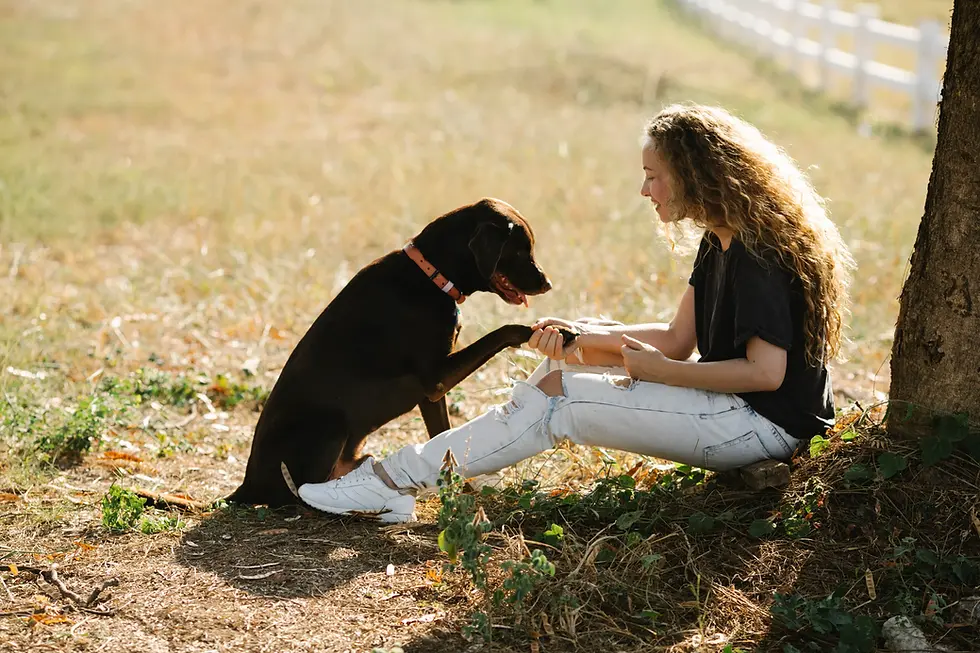
Six reasons your Labrador follows you
1. He was born watching people. In 2021, Emily Bray and colleagues at the University of Arizona tested 375 Labrador and Golden Retriever puppies, aged eight to ten weeks, from the assistance-dog charity Canine Companions. Shown a pointing gesture, the puppies chose the right cup about 67% of the time, against 50% by chance, before they'd had any real training. Genetics explained more than 40% of the differences between puppies in following a point and in looking at people's faces (Bray and colleagues, Current Biology, 2021). One caveat: these puppies came from a breeding programme designed to produce dogs who work with people, so they may be more people-focused than the average Lab. But the direction is clear. Paying attention to humans starts early. Following you round the house is simply the walking version.
2. Watching the handler was his job. A retriever works by keeping an eye on the person, waiting for the signal and staying in range. Generations of gundogs were bred to do exactly that, and a dog who kept tabs on his handler got the work. Your Labrador has no pheasants to collect, so he keeps tabs on you instead.
3. Food happens near you. For a Labrador, this probably deserves to be reason number one. The kitchen, the fridge, the snack cupboard and the sandwich in your hand all involve you. A dog this food-motivated has every reason to stay close to the most likely source of a dropped crust.
4. He's learned your routine. Labradors are very good at patterns. Coat means walk. Keys mean car. The click of the oven means dinner, eventually. Following you is partly him checking which pattern is about to start.
5. He doesn't like missing things. Labradors are sociable and curious. If something is happening in another room, he would like to be there for it, even if it turns out to be you looking for a charger.
6. You're his safe place. A Labrador who's attached to you feels more settled, and braver, when you're close. Researchers at the University of Vienna showed a version of this in 2013 with pet dogs of various breeds. Given a puzzle toy with food inside, dogs kept working at it when their owner was in the room, and gave up much sooner when the owner was absent. A stranger standing in didn't have the same effect (Horn, Huber and Range, 2013, reported by the Christian Science Monitor). Researchers call it a 'secure base' effect, the same idea used for toddlers. Following you is partly how he keeps his secure base in sight. If he can't relax at all once you're out of it, that's a different issue, covered in our guide to clingy Labradors.
The line between a happy shadow and an anxious one is worth understanding, and it has its own post.
👉 WHY ARE LABRADORS SO CLINGY? — Needy, Velcro or Anxious?
The look: why he follows you with that face
A Labrador doesn't just follow you. He arrives, sits, and looks up with an expression that suggests he hasn't eaten since the previous administration.
That expression has a history. In 2019, Juliane Kaminski and colleagues at the University of Portsmouth compared the facial muscles of dogs and wolves. Dogs, but not wolves, had a well-developed small muscle that lifts the inner eyebrow and makes the eyes look bigger and sadder, and in behaviour tests dogs used it more often than wolves when a person was looking at them (Kaminski and colleagues, PNAS, 2019). It was a small study, with only a handful of animals dissected, so it's best read as a strong hint rather than the last word. Earlier work by the same team found shelter dogs who made the movement more often were rehomed faster.
Put that together with a breed that watches faces from puppyhood, and the stare in the kitchen is no accident. It's a very old trick, aimed at your sandwich.
The kitchen shadow
If there's one room where Labradors follow most closely, it's the kitchen. Many owners can't open the fridge without finding a Labrador standing exactly where the door needs to swing.
This is following with a purpose. Every time something edible has landed on the floor, every time a carrot end has been handed down, the kitchen has paid out. Because it only pays out some of the time, the habit gets stronger, not weaker. It's the same reason people keep feeding fruit machines.
It's also a safety issue. A large dog under your feet near hot pans and sharp knives is how cooking accidents happen, and kitchens contain plenty that's dangerous for dogs to eat.
The supper inspector
Month two. You start chopping onions. He arrives at once and sits, very upright, beside your left foot. You move to the hob. He moves to the hob. You open the fridge. He's already looking into it. You step back and trip over him, and the wooden spoon goes flying. He catches it. He looks extremely pleased with himself. You decide that something needs to change.
If food is behind most of the following, it's worth understanding just how strong a Labrador's appetite really is.
👉 WHY ARE LABRADORS ALWAYS HUNGRY? — The Science Behind the Appetite
Living with a Labrador shadow
Day to day, most owners find it lovely, with the occasional trip hazard. You have a companion for every chore, a witness to every snack and a large, warm presence at your feet wherever you happen to sit.
The practical side is that a 30-kilo shadow takes up room. He'll lie in doorways, across the bottom of the stairs and directly behind you when you step backwards. Jess's owner also notes that she "cuddles into me to get her ears rubbed", which, multiplied by every time you sit down, adds up to a lot of ear-rubbing.
A Labrador probably isn't the right fit if:
you like to move around your home without supervision
you'd find a large dog always underfoot more annoying than endearing
you want a dog who'll happily stay in another room while you work
nobody's at home much during the day
The working-from-home day
Month four. Your first full day working from home since he arrived. He follows you to the desk and lies under it. He follows you to the kettle. He follows you to the front door when the post comes, and back. At lunchtime you sit down with a sandwich and find him already sitting, gazing at it. By three o'clock, you've realised he's had a far more active day than you have.
A Labrador with a proper outlet for all that energy is a calmer, less constant shadow.
👉 HOW MUCH EXERCISE DOES A LABRADOR NEED? — Daily Routine, Age & Energy
Labrador shadow habits, decoded
Some following habits are pure Labrador, and most owners will recognise at least four.
Lying in doorways. A doorway lets him monitor two rooms and every exit at once. It's not laziness. It's strategy, laid out flat in exactly the spot you need to walk through.
Bringing you something. Many Labradors greet you, or follow you, with a shoe, a sock or a soft toy in their mouth. It's the retriever in him: carrying is comforting, and bringing things to his person is what he was bred to do. The sock is a gift. Its other half has usually been eaten.
Leaning while you stand. If he catches up with you in the kitchen, he'll often lean his full weight against your legs. Affection and reassurance in one move, and the reason Labrador owners develop a particular way of standing at the hob.
The bathroom vigil. He waits outside, or lies with his nose to the gap, and greets you afterwards as if you've returned from a long voyage.
The night check. Some Labs get up in the night, pad round to check where everyone is, then go back to bed. Harmless in a young dog. Worth a mention to your vet if it starts suddenly in an older one.
Following you to the car. Keys, shoes and the front door mean an outing may be about to happen. He would like it noted that he's available.
How to teach a Labrador to wait at the door
You don't need to stop your Labrador following you. It helps enormously, though, if he can pause on request, especially at doors, gates and the top of the stairs.
Step one: start at an inside door. Stand at a closed door with him beside you. Put your hand on the handle. If he stays still, say 'yes' and give him a treat. If he surges forward, take your hand away and wait.
Step two: open it a crack. Open the door slightly. If he holds still, reward. If he moves towards the gap, close it gently. He'll quickly work out that staying still is what makes doors open.
Step three: add the word. Once he's reliably pausing, say 'wait' just before you open the door, then release him with 'OK' to follow you through.
Step four: build it up. Open the door wider, step through yourself, then come back and release him. Then the front door, with him on the lead. Then the car.
Step five: use it everywhere. A Lab who waits at doors doesn't knock you over, doesn't bolt into the road and doesn't charge down the stairs ahead of you. It turns the shadow into a well-mannered one.
The kitchen mat: somewhere to follow to
The kindest fix for the kitchen shadow isn't to shut him out. It's to give him a spot to be in. A mat just outside the cooking area, or at the edge of the room, gives him a front-row view without being under your feet.
Start by rewarding him for stepping onto the mat, then for lying down on it. Add a word, such as 'mat'. Gradually ask for longer stays while you move around the kitchen, paying generously at first. Most Labradors take to this quickly, because they're still in the room where the food is. As far as he's concerned, nothing has changed except his seating arrangements.
Use pieces of his normal food for the rewards, taken from his daily allowance. A Labrador who's paid in kibble to lie on a mat is still a Labrador eating kibble, and the scales will notice if you add extra.
What not to do with a Labrador shadow
Don't punish the following. He isn't misbehaving. Telling him off just makes him uncertain about where he stands with you.
Don't feed him while you cook. One carrot end teaches him that standing under your feet is profitable. A reward on the mat teaches him that the mat is.
Don't shut every door at once. If he's had access to the whole house, closing him out suddenly will cause frustration and, often, barking. Build up time on the other side of a door gradually.
Don't ignore sudden changes. A Labrador who starts following far more than usual, or stops following altogether, may be unwell or sore. Labradors are prone to joint problems as they age, and a change in behaviour is often the first sign.
Is it OK for a Labrador to have one favourite person?
Yes, and it's common. Usually it's whoever does the feeding, the walks and the training sessions, though rescues sometimes choose the person who took them in and never look back, as Retrieve's owner found.
The only risk comes when that person isn't there. A holiday, a hospital stay or a new job can leave a one-person Labrador unsettled. The fix is simple: let other people do the walk, the evening meal or a training session a few times a week. He'll still have a favourite. He'll just also know the rest of the household is good for a biscuit.
If his favourite person goes away and he becomes properly distressed, rather than just a little flat, that's an attachment question rather than a following one, and our guide to clingy Labradors covers it in detail.
Why older Labradors often follow more
Many owners notice their Labrador becomes more of a shadow in later life. Fading eyesight and hearing make the world less predictable, so staying close to a familiar person makes sense. Stiff joints can make him reluctant to be left on another floor, and the night-time trips to check where everyone is can increase.
A few small changes help: a bed in each room you spend time in, rugs on slippery floors, a gate on the stairs if they're getting difficult, and a night light. If an older Labrador seems confused, restless at night or unusually anxious, mention it to your vet, as age-related changes can often be eased.

How to keep the following healthy
The aim isn't to stop your Labrador wanting to be near you. It's to make sure following is a choice, not a compulsion.
In the moment
Let him come with you, but reward him for lying down when you settle.
Use 'wait' at doors and stairs, and release him to follow.
In the kitchen, send him to his mat and pay him there, not at your feet.
Long term
Practise being in different rooms. Pop into another room for a minute, close the door, come back calmly. A Lab who's used to brief separations follows you because he wants to, not because he has to.
Spread the routine. If everyone in the house takes turns feeding and walking him, he'll be just as happy following whoever is home.
Give the brain a job. Scent games, puzzle feeders and a little training each day tire a Labrador out in a way that following you to the kettle doesn't.
Keep the exercise regular. A Labrador who's had a proper walk spends far more of the afternoon asleep, and far less of it supervising you.
Watch the waistline. Plenty of following is food-led, so feed him at set times, use his daily allowance for training treats and keep the snacks off the counter.
The mat
Month ten. You start cooking. He trots into the kitchen, looks at you, and lies down on his mat by the door without being asked. He watches every move you make, nose twitching at the onions. When you've finished, he gets a handful of his kibble on the mat. He's still following you. He's just doing it from a respectable distance.

When to get help: if your Labrador can't settle at all when you're out of sight, howls or damages doors when left, or suddenly starts following much more or much less than usual, talk to your vet. Pain, illness and separation stress can all show up as changes in following.
Do Labradors follow more than other breeds?
Compared with independent breeds such as Huskies or many terriers, yes. Compared with other gundogs, such as Golden Retrievers and Spaniels, they're very similar, which makes sense given the job they were all bred for. The Labrador's particular twist is food. Plenty of breeds follow you to the bathroom. A Labrador follows you to the bathroom via the kitchen.
Some Labradors add a running commentary to the following, especially at the front door.
👉 DO LABRADORS BARK A LOT? — Why Labs Bark and What Helps
Having a large, devoted shadow is one of the trade-offs, and joys, that new owners weigh up.
👉 LABRADOR PROS AND CONS — Are Labs High Maintenance?
What Labrador owners realise over time
Most owners stop noticing the following, and start noticing when it isn't there. A Labrador who quietly trails you from room to room is doing something his breed has done for generations: keeping an eye on his person. The work is simply in giving him somewhere sensible to be when he gets there.
The escort, a year on
A year after that first evening of eleven trips to the kitchen. You get up for a glass of water. He lifts his head, considers it, and puts it back down on his paws. You come back. He thumps his tail twice. He still follows you everywhere. He's just learned which trips are worth getting up for.
The verdict
Why do Labradors follow you everywhere? Because they're born watching people, bred to work within sight of a handler, and endlessly interested in food, routine and whatever you're about to do next. It's normal, and usually a sign of a well-bonded dog.
Keep it easy to live with by teaching a 'wait' at doors, giving him a mat in the kitchen, sharing his care around the household and making sure he's well exercised. If he can't settle when he can't see you, that's the point to look more closely.
If you're still getting to know the breed, the guide covers the full picture.
Living with a Labrador means never going to the fridge alone again. The Labrador range is for people who've stopped expecting to.
👉 Explore Labrador women's t-shirts, unisex t-shirts and sweatshirts and hoodies
👉 or explore the full LABRADOR COLLECTION
Got a Labrador who escorts you to every room in the house? Show us. Tag @doggystylesinc on Instagram or find us on Facebook at Doggy Styles Inc, and your Labrador could feature in a future post.
Continue Understanding the Labrador Breed
FAQs
Why does my Labrador follow me everywhere?
Labradors are bred to watch and work with people, and they're very interested in food, routine and what you're doing next. Following you is normal for the breed.
Why does my Lab follow me to the bathroom?
He's keeping track of you and doesn't want to miss anything. It's normal unless he's distressed when the door is closed.
Why does my Labrador follow me into the kitchen?
Because the kitchen is where food happens. If it's ever paid off, even occasionally, he'll keep coming. A mat to wait on helps.
Is it normal for a Labrador to follow one person?
Yes. Labs usually follow whoever feeds, walks and plays with them most. Sharing those jobs spreads the attention.
Do Labradors follow you because they love you?
Partly. Following reflects a close bond, but curiosity, routine and food play a big part too.
When should I worry about my Labrador following me?
If he can't settle when you're out of sight, panics when you leave, or suddenly follows much more or less than usual, talk to your vet.
How do I stop my Labrador following me everywhere?
You don't need to stop it. Teach 'wait' at doors, a mat in the kitchen and short spells in different rooms, so following is a choice rather than a need.
Why does my older Labrador follow me more?
Fading senses, stiff joints and age-related changes can make an older Lab want to stay close. Mention any big change to your vet.
Why does my Lab lie in doorways?
Doorways let him keep track of more than one room, and of you, at the same time. It's a very efficient place to supervise from.
Are Labradors affectionate dogs?
Very. Most are sociable, people-focused and happy to be close to their family, and often to anyone else who'll rub their ears.
Do Labrador puppies follow you everywhere?
Most do. Puppies follow closely for safety and company. It's a good time to start teaching short, calm separations.
Does following mean my Labrador is bored?
Sometimes. A Lab without enough exercise and mental work often follows more. More walking, sniffing and puzzle games usually help.


Comments