


Why Are Labradors So Clingy? (And Are Labs Needy Dogs?)

Updated: 1 day ago
By Nick, co-founder of Doggy Styles Inc and owner of Bruno, a rescued French Bulldog. Last updated 15 October 2026.
Quick Answer
Most Labradors are affectionate rather than truly clingy. They were bred to work alongside people, so wanting to be near you is built in, and following you round the house is normal. Clinginess becomes a problem when that attachment tips into distress: a Lab who can't settle unless he's touching you, panics when you leave or can't cope with even short spells alone. That's over-attachment or separation-related distress, and it's what this guide covers: how to tell the difference, how long a Lab can be left, and how to build a dog who's devoted when you're home and calm when you're not.
Key takeaways
Affection and following are normal. Distress when you're apart is the problem to solve.
Over-attachment usually builds from total access and no practice at being alone.
Most adult Labradors shouldn't be left for more than about four hours, and being alone has to be taught.

If you're still getting to know the breed, start here:
👉 LABRADOR GUIDE — Full Behaviour, Personality & Ownership Breakdown
Why are Labradors so clingy? What people get wrong
Most people assume a clingy dog is an insecure one, or a spoilt one. With a Labrador, it's usually neither. He's a dog who was bred to spend his working day within arm's reach of a person, and he sees no reason to change the arrangement now that he's retired to your sofa.
Owners describe it with affection and the occasional sigh. Max's owner, on Purina's owner stories, says he "steals my pyjamas when he knows it is a day I am going to work!", then lies on them in his bed until she comes home. The same owner adds: "He recognises my emotions aswell... if ever I have had a bad day he knows and comforts me." Both of those come from the same trait. One is just more convenient than the other.
A note on the stories in this post: the dated moments (week one, month two and so on) are illustrative scenes based on common Labrador owner experiences, not the story of one real dog. The owner quotes are real, and link to where they were published.
The closed door
Week one. You step into the next room to take a phone call and close the door behind you. Within seconds there's a whine, then a scrabble of claws, then a heavy thud as he lies down against the other side of it. You've been gone for ninety seconds. When you open the door he falls in, delighted and slightly offended. You realise he has never once been on the other side of a door from you.
Velcro, needy or anxious? A quick guide
What you see | Usually means | What helps |
Leans on you, lies on your feet | Affection and reassurance. Normal. | Nothing. Enjoy it. |
Follows you between rooms but settles when you sit | Velcro, not anxious | A comfy bed near where you sit |
Nudges, paws or brings toys all evening | Learned attention-seeking | Reward calm, don't reward the nudge |
Whines or scratches at a closed door | Finding short separations hard | Practise short absences, build up slowly |
Howls, chews exits or toilets indoors when left | Separation distress | Your vet, then a qualified behaviourist |
Most Labradors live firmly in the top two rows, and those are covered in our guide to why Labradors follow you everywhere. This guide is about the bottom three: the point where wanting to be close turns into not coping when he can't be.
That warm, slightly overbearing devotion is what Doggy Styles Inc designs around: clean, minimal Labrador pieces for people who haven't had the sofa to themselves since the puppy came home.
👉 Shop Labrador women's t-shirts, unisex t-shirts and sweatshirts and hoodies
👉 or explore the full LABRADOR COLLECTION

Why are Labradors so attached to people?
Bred as a working partner
The Labrador's ancestors worked alongside fishermen in Newfoundland before being taken up by British shooting estates. A retriever's job is to watch the person, wait for the signal, fetch the bird and bring it straight back to hand. A dog who wandered off to pursue his own interests was no use to anyone. Generations of breeding for that close teamwork produced a dog who is, at heart, most comfortable when he knows exactly where his person is.
Chosen for cooperation ever since
That people-focus is why Labradors became the backbone of assistance-dog work. Guide Dogs lists Labradors among the most common pure breeds in its breeding programme, and says the Golden Retriever crossed with the Labrador "has produced the most successful guide dog of all". Breed for a dog who wants to stay close, pay attention and work with a person all day, and that's what you get. Your Labrador simply has nobody to guide but you.
What the research says
Dogs don't just like their owners. They form attachments that look a lot like a young child's attachment to a parent. In 1998, József Topál and colleagues at Eötvös Loránd University in Budapest adapted the 'Strange Situation' test, originally designed for human infants, and ran it with 51 adult pet dogs of various breeds and their owners. The dogs showed clear attachment behaviour, and could be described as more or less securely attached, much as children are. Breed made little difference to most of the behaviours measured (Topál and colleagues, Journal of Comparative Psychology, 1998). It's a single lab-based study, and it wasn't about Labradors specifically, but it's been the foundation for much of the dog attachment research since.
Two things follow. A clingy Labrador is behaving like an attached dog, which is a good thing. And attachment comes in secure and insecure versions. The aim with a Lab isn't less attachment. It's the secure kind: close when you're there, calm when you're not.
He reads the room
Max's owner says he knows when she's had a bad day. Research suggests dogs do respond to our distress, though it's worth being careful about what it shows. In 2012, Deborah Custance and Jennifer Mayer at Goldsmiths, University of London, had owners and a stranger take turns to talk, hum or pretend to cry near 18 pet dogs of various breeds. The dogs approached the crying person far more often than the humming one, and did it in a submissive, comforting way, whether the person crying was their owner or a stranger (Custance and Mayer, Animal Cognition, 2012). It was a small, exploratory study, and the researchers said it could reflect learned responses rather than empathy as we'd understand it. Labrador owners tend to reach their own conclusions.
It's also part of why a clingy Lab sticks closer when the house is tense, someone's unwell or routines are upside down. He isn't being difficult. He's checking in.
Clinginess and following are related, but not the same thing. The shadowing has its own habits and its own fixes.
👉 WHY DO LABRADORS FOLLOW YOU EVERYWHERE? — The Labrador Shadow Explained
Over-attached or anxious? What the terms mean
The words get used loosely, so it's worth separating them, because they need different help.
Over-attachment (sometimes called hyper-attachment) is a dog who needs to be with one particular person all the time. He follows that person from room to room, can't settle on his own bed even when they're in the same room, and gets upset when a door closes between them, even if other people are home.
Separation-related distress happens only when he's left. Some dogs are upset by being alone at all, and are fine with anyone for company. Others are upset specifically by the absence of their person, and another human doesn't help much.
Normal attachment sits underneath both: a Lab who likes to be near you, greets you warmly and checks where you are, but copes when you're not there.
How common is the problem end? In a survey of 13,700 Finnish pet dogs, researchers at the University of Helsinki found separation-related behaviour in about 5% of dogs (Salonen and colleagues, Scientific Reports, 2020). That figure covers all breeds and relies on owner reports, so it's a rough guide rather than a Labrador statistic. The useful point is that true separation problems are a minority, and very treatable.
A simple test helps: when you go out, does it help if someone else stays home? If yes, it's mainly about being alone. If he's just as upset, it's about you, and the work focuses on building his confidence away from his favourite person.
How a Labrador's clinginess grows
A Labrador puppy arrives already wired for people. What happens next decides whether that becomes easy-going affection or something more anxious.
The quickest route to an over-attached Labrador is total access: carried everywhere, asleep on you, never on his own, usually because the first weeks at home are the weeks you've taken off work. Then one Monday the house empties. He hasn't learned that being alone is ordinary. He's learned that it doesn't happen. It's nobody's fault. It's just very easy to do with a dog who's this pleasant to have on your lap.
Attention is the other lever. Labradors learn quickly, and a nudge that gets a stroke, a paw that gets a biscuit or a whine that opens a door will all be repeated, with enthusiasm. None of that is anxiety. It's a sociable dog who has worked out what works.
The first Monday
Month two. Your fortnight off ends. He's been on your lap, at your feet and on your bed for fourteen days. On Monday morning you pick up your keys and he's at the door before you are. You leave. On the camera on your phone, you watch him lie with his nose to the gap under the door for forty minutes. It isn't a disaster. It is a lesson. You start practising short absences that evening.
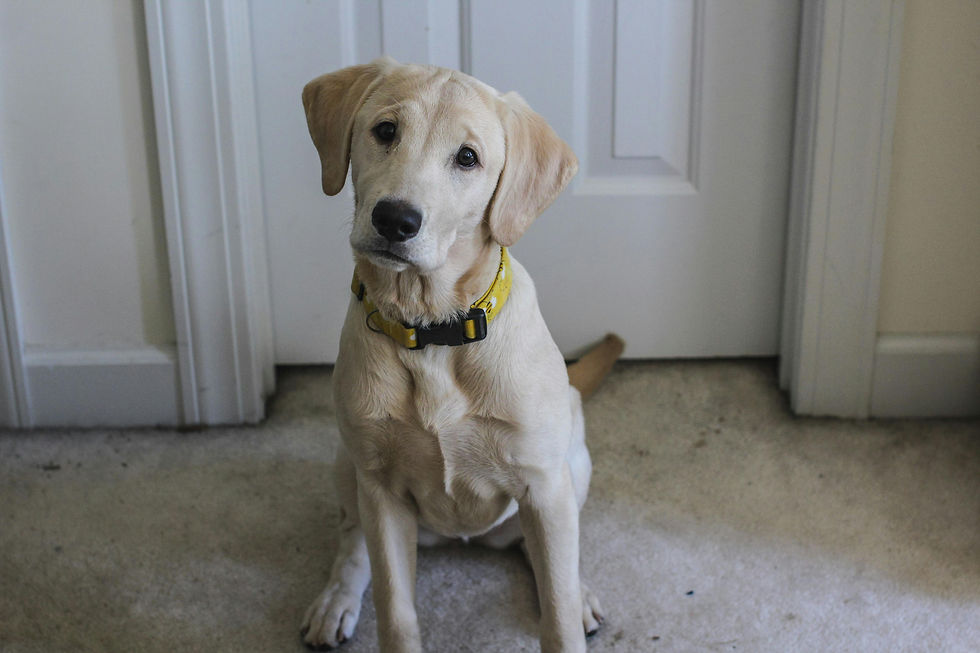
A tired, well-exercised Labrador copes far better with time on his own.
👉 HOW MUCH EXERCISE DOES A LABRADOR NEED? — Daily Routine, Age & Energy
Living with an over-attached Labrador
Living with an over-attached Labrador is more tiring than it sounds. He won't settle until you sit down, and won't stay settled if you stand up. He lies across doorways so he'll know if you leave. He watches the coat hooks. A trip to the bins becomes an event, and a trip to the shops becomes a negotiation.
The flip side shows up when the door closes. Retrieve's owner on Purina's owner stories lists "Scratching the kitchen door if she is outside by herself for the least amount of time" among her biggest challenges. Plenty of Lab owners will know that door, and the state of its paintwork.
There's also the matter of size. A Labrador typically weighs somewhere between 25 and 36 kilos, and a dog that size who wants to be on your feet, in your lap and between you and the television takes up real space. Affection, in this breed, comes in a large format.
A Labrador probably isn't the right fit if:
the dog would be alone for most of the working day
you want a dog that's content to amuse himself in another room
you'd find constant physical contact more tiring than lovely
nobody in the house has time for company and training as well as walks
The handover
Month four. You go away for the weekend and leave him with your partner. Normally he's glued to you. On Saturday morning he waits by the front door for an hour. Then your partner picks up the lead and the treat bag, and he decides, on balance, that he can work with this. By Sunday night he's asleep on the wrong side of the bed.
Spreading the bond across the household is one of the most useful things you can do, and it's a big part of why Labradors suit family life so well.
👉 ARE LABRADORS GOOD FAMILY DOGS? — Children, Energy & Everyday Life
How long can a Labrador be left alone?
This is where a clingy Labrador meets modern working life. The RSPCA advises leaving dogs for no longer than four hours, so they can exercise, go to the toilet and spend time with people, and says the right length depends on the individual dog. For a breed this sociable, four hours is a ceiling, not a target.
Puppies. Minutes, building up slowly. A young puppy also needs the toilet far more often than an adult, so long absences aren't realistic anyway.
Adolescents, roughly six to eighteen months. Up to an hour or two, once he's been taught, with something to chew. This is also the age at which bored Labradors find out what skirting boards taste like.
Adults. Up to about four hours once he's genuinely comfortable alone, ideally after a walk and with a stuffed chew to work on.
Seniors. Often less. Older Labradors may need the toilet more often and can be more unsettled by changes in routine.
If you work full days, the answer isn't to leave him and hope. It's a dog walker at lunchtime, day care a few days a week, a neighbour, or a family member who's home. Most Labradors take to these arrangements well, because they like people in general, not only you. That's convenient. It's also slightly humbling.
Working full time? Your options compared
Most Labrador owners who work away from home need some help. Here's how the usual options stack up for this particular breed.
Option | Good for | Watch out for |
Dog walker | A proper midday outing, a toilet break and company | Off-lead group walks near water. Your Lab will find it |
Doggy day care | Company all day for a dog who likes everyone | Over-excitement. Some Labs come home tired, others come home wired |
Pop-in visits | A toilet trip and a fuss at home | A 20-minute visit won't cover a long gap on its own |
Family, friends or neighbours | Familiar faces and flexibility | Agree the food rules first. Labradors are excellent at finding the soft touch |
Working from home some days | Fewer long days alone | He still needs practice alone, or office days will feel worse |
For many owners, a mix works best: home on some days, a walker on office days and a trusted neighbour on standby. The test is simple. No day should leave him alone for longer than he can comfortably manage.
Signs your Labrador's clinginess has tipped into anxiety
Most clingy Labs are simply affectionate. A few are genuinely struggling, and the signs are usually clear once you know where to look.
As you get ready to leave. Pacing, panting, whining or trying to get between you and the door as soon as the coat and keys appear.
While you're out. Barking or howling that goes on and on, scratching or chewing at doors and windows, accidents indoors from a dog who's otherwise house-trained, or heavy drooling. A camera, or a word with a neighbour, tells you more than the state of the house does.
When you come home. A greeting that's frantic rather than happy, and takes a long time to settle.
When you're home. Unable to settle unless he's touching you, and distressed if you go into another room and close the door.
If you're seeing these, act early. Separation problems are far easier to improve before they become a habit, and your vet can rule out medical causes and refer you to a qualified behaviourist.
How to read the camera
Relaxed: he watches the door for a minute or two, has a sniff about, works on his chew, then flops down and sleeps. He may get up, rearrange himself with a sigh and go back to sleep. A Labrador asleep on his back with all four legs in the air is about as relaxed as dogs get.
Struggling: pacing, whining, howling or barking that carries on beyond the first few minutes, lying with his nose pressed to the gap under the door, panting when it isn't warm, ignoring a chew he'd normally demolish, or scratching at the exits. For a Labrador, the ignored chew is the big one. A Lab who's too worried to eat is a very worried Lab.

What to leave a Labrador with when you go out
The first few minutes after the door closes are usually the hardest. A Labrador's nose and appetite make filling them easy, as long as you plan for his jaws as well.
Frozen stuffed toys. A tough rubber toy stuffed with part of his breakfast, a spoonful of wet food or plain yoghurt, then frozen overnight, can keep a Lab busy for a good while. Choose the heavy-duty versions. A standard toy lasts most Labradors about as long as a sandwich.
Lick mats and snuffle mats. Licking is soothing for many dogs, and a snuffle mat puts his retriever's nose to work on his kibble. Both slow down a dog who would otherwise eat his entire meal in the time it takes you to find your keys.
Scatter feeding. Scatter part of his food across a safe room or the garden. It turns a meal into a search, which suits a dog bred to find things for a living.
Take it from the daily allowance. Every bit of food you leave him with should come out of his daily ration. Around a quarter of Labradors carry a gene variant that makes them hungrier than other dogs, so 'a little extra to keep him busy' adds up quickly.
Safety first. Only leave toys he can't break into swallowable chunks, and check them often. Labradors have a well-earned reputation at the vet for eating things they shouldn't, and a long day alone is when it tends to happen.
Crate, room or pen? Setting up the space
Where you leave him matters as much as how long. A Labrador left in a room with a bin, a tea towel and a pair of trainers isn't alone. He's been given a project.
Choose a safe room or pen. A kitchen or utility room with the bins out of reach, shoes put away and cables tidied. Labradors don't need much space while you're out. They need nothing to eat that isn't food.
If you use a crate, make it a den. It needs to be big enough for an adult Lab to stand, turn round and lie flat on his side, with a blanket over the top. Build it up slowly: meals in there with the door open, then the door closed for a few seconds while you're in the room, then a few minutes, then while you potter round the house. Only then start leaving the house.
Know when it isn't working. A crate isn't a fix for a long day or for real panic. If he drools, scratches or bends the bars, he's telling you something. Swap to a puppy-proofed room and go back to shorter absences.
Leave water, a bed and quiet. A radio or audiobook at low volume can help mask outside noises, especially for a dog who reacts to the post arriving.
How to build a calm, independent Labrador
The aim isn't to push him away. It's to teach him that being apart is ordinary, and that nothing bad happens while you're gone.
In the moment
Keep goodbyes and hellos boring. A calm 'see you later' beats a heartfelt farewell.
Reward him for settling on his own bed, not only for lying on you.
If he nudges or paws for attention, wait for a calm moment, then give it generously.
Long term
Practise tiny absences. Start with seconds: step out of the room, close the door, come back before he worries. Build to minutes, then to leaving the house. The RSPCA's guidance is to move on only when he's relaxed at each stage, and that once a dog is comfortable for an hour, longer periods are usually manageable.
Teach a settle. A comfy bed near where you sit, a word like 'settle', and a reward every time he chooses to lie there. It gives him somewhere to be that isn't you.
Make leaving the start of something good. A stuffed rubber toy or a long-lasting chew handed over as you go turns your departure into an event he quite looks forward to. Take the food from his daily allowance. A Labrador will happily trade independence for calories, and he doesn't need extra.
Share the caring. If one person does all the feeding, walking and fussing, that's who he'll fixate on. Spread the jobs around the household, so his world doesn't stop when one person goes out.
Wear him out first. A walk with time to sniff, or a short game of fetch, before you leave means he's far more likely to sleep than to fret. A tired Labrador is a much less worried one.
Teach the basics with patience. Calm, short, reward-based training builds a confident dog, and a confident dog copes better on his own. Shouting has the opposite effect.
👉 HOW TO TRAIN A LABRADOR PUPPY — Calm, Reward-Based Foundations
The quiet house
Month ten. You pick up your keys. He looks up from his bed, watches you put your coat on, and accepts the stuffed chew you hand him with some dignity. You leave. On the camera, he works on the chew for twenty minutes, then sleeps until he hears your car. He's at the door when you open it, tail going. Pleased. Not frantic. Exactly as it should be.

When to get help: if your Labrador panics, howls, destroys doors or toilets indoors whenever he's left, talk to your vet. The same goes for a Lab who suddenly becomes much clingier than usual, as pain, illness and fading senses can all make a dog want to stay close. Your vet can rule out medical causes and refer you to a qualified behaviourist.
Calming aids: what the evidence says
There's a whole aisle of products promising a calmer dog. Here's what the research actually supports.
Audiobooks. In a study of 31 dogs in a rehoming kennels, Clarissa Brayley and Tamara Montrose found the dogs spent more time resting and less time sitting or standing alert when an audiobook was playing, compared with classical music, pop, 'dog music' or silence (Brayley and Montrose, 2016). Your kitchen isn't a kennels, but a calm voice on a speaker costs almost nothing.
Pheromone diffusers. Widely sold and unlikely to hurt, but a 2021 evidence review by Chun Fung Wong and Merran Govendir rated the evidence as weak and said a true clinical benefit is undetermined (Wong and Govendir, 2021). Pleasant smell. Unproven effect.
Medication. For genuine separation anxiety, your vet can prescribe medication. In the UK, clomipramine is authorised as an aid in treating separation-related disorders, but only alongside behavioural training (Veterinary Medicines Directorate). It turns the panic down so the training can work. It doesn't do the training for you.
What not to do with a clingy Labrador
Don't tell him off afterwards. Coming home to a chewed skirting board is frustrating. But he can't connect your crossness with something he did two hours ago, and the 'guilty look' owners see is mostly a reaction to the owner's mood, not the dog's conscience. All he learns is that your return is unpredictable.
Don't sneak out. Slipping out while he's distracted feels kinder. To a clingy dog it just means you might vanish at any moment, so he watches you even more closely.
Don't rely on a big bowl of food. A Labrador will finish it in forty seconds and spend the remaining three hours and fifty-nine minutes missing you.
Don't get a second dog to fix it. Some Labs enjoy the company, but most separation problems are about missing their person, not missing a dog. You may end up with two unsettled Labradors and a much bigger food bill.
Don't use a bark collar. It punishes the noise, not the worry behind it, and can make an anxious dog considerably worse.
Don't wait for the first long day. The weekend before you go back to work is too late to start. Build up alone time weeks in advance.
Rescue Labradors, retired guide dogs and older Labs
Rescues. A rescue Labrador may arrive with a history you'll never fully know, and a change of home can make being left harder for the first few weeks. Give him a week or two to settle, then start right back at seconds, even if he's an adult. Many rescues become very attached very quickly. That's the good news and the homework.
Retired and withdrawn assistance dogs. Some families adopt a Lab who has retired from guide or assistance work, or who left training early. These dogs are usually beautifully trained and deeply people-focused, and many have rarely been alone. Treat time alone as a new skill, not something he should already know.
Older Labradors. Fading hearing and eyesight, stiff joints and age-related changes in the brain can all make an older Lab want to stay closer, and cope less well with long absences. Shorter gaps, a soft bed on the ground floor, a night light and a midday visit help. A sudden change in how an older dog copes is always worth mentioning to your vet.
Are Labradors clingier than other breeds?
Compared with independent breeds such as Shiba Inus or many terriers, yes, noticeably. Compared with other gundogs and companion breeds, such as Golden Retrievers, Cavaliers and Poodles, they're much the same. The difference is scale. A clingy Cavalier sits on your lap. A clingy Labrador sits on most of you.
That sociable, people-first streak runs through the whole Labrador personality.
👉 LABRADOR PERSONALITY — What Labs Are Really Like
What Labrador owners realise over time
Most owners stop worrying about the clinginess and start appreciating it. A Labrador who leans on you, sleeps at your feet and comes to find you after a bad day is doing exactly what he was bred for. The work is in making sure he's just as content when you're out.
The closed door, a year on
A year after that first thud against the door. You step into the next room to take a call and close the door. Nothing. No whine, no scrabble. When you come out he's asleep on his bed in a patch of sun, and he opens one eye to check it's you. He still adores you. He just no longer needs to see you to know you're there.
The verdict
Why are Labradors so clingy? Because they were bred to work side by side with people, and generations of selection for cooperation have produced a dog who's happiest close to his family. Leaning, following and checking in are normal Labrador attachment.
It only becomes a problem when it tips into distress. Keep goodbyes calm, practise short absences, give him a bed of his own and something to do while you're out, and you'll have a Labrador who's devoted when you're home and relaxed when you're not.
If you're still getting to know the breed, the guide covers the full picture.
Living with a Labrador means never sitting down without company. The Labrador range is for people who'd miss it if they did.
👉 Explore Labrador women's t-shirts, unisex t-shirts and sweatshirts and hoodies
👉 or explore the full LABRADOR COLLECTION
Got a Labrador who treats your lap as a public bench? Show us. Tag @doggystylesinc on Instagram or find us on Facebook at Doggy Styles Inc, and your Labrador could feature in a future post.
Continue Understanding the Labrador Breed
FAQs
Why are Labradors so clingy?
They were bred to work closely with people, so most clinginess is normal attachment. It becomes a problem only when it comes with distress when you're apart.
Are Labradors needy dogs?
They need more company than many breeds, but that isn't a problem as long as they can also settle calmly on their own.
What's the difference between a clingy Labrador and an anxious one?
A clingy Lab wants to be near you but copes when he can't be. An anxious one shows distress when separated: pacing, panting, whining, howling, damaging exits or toileting indoors.
Can a Labrador be too attached to one person?
Yes. If he can't settle unless one particular person is in sight, even when others are home, that's over-attachment. Sharing his care and building time apart gradually helps.
Why is my Labrador suddenly so clingy?
Changes in routine, a house move, a new baby, pain, illness or fading eyesight and hearing can all make a dog want to stay closer. If it's sudden, check with your vet.
Do Labradors get separation anxiety?
Some do. Signs include panting, howling, destructive behaviour or accidents when left. Act early and talk to your vet.
How long can a Labrador be left alone?
The RSPCA advises no longer than four hours for dogs. Puppies and many seniors need far shorter absences.
Can I leave my Labrador while I'm at work?
Not for a full working day. A lunchtime dog walker, day care or someone at home for part of the day makes it work.
Will a second dog stop my Labrador being clingy?
Rarely. Most over-attached or anxious Labs are missing their person, not a dog. Work on time alone first.
Are male or female Labradors more clingy?
There's no good evidence either way. The individual dog and how he's raised matter far more.
How do I make my Labrador less clingy?
Practise short absences, teach him to settle on his own bed, give him a chew when you leave, share the caring and make sure he's well exercised.
Is it bad to let my Labrador sleep in my bed?
It's a personal choice. What matters more is that he also gets used to spending some time apart from you during the day.


Comments