


Labrador Personality Traits: Why Labs Are So Friendly

Updated: 1 day ago
By Nick, co-founder of Doggy Styles Inc and owner of Bruno, a rescued French Bulldog. Last updated 15 October 2026.
Quick Answer
The Labrador personality is friendly, food-driven, eager to please and slow to grow up. The Kennel Club's breed standard describes the Labrador as "Intelligent, keen and biddable, with a strong will to please", with a "Kindly nature, with no trace of aggression or undue shyness." In real life that means a dog who likes almost everyone, learns quickly for a reward, loves water and carrying things, and stays bouncy for longer than most people expect. Working-line Labs tend to be busier and keener to retrieve than show-line Labs, but the core temperament is the same.
Key takeaways
Friendly, biddable and people-focused: bred to work with a handler, not alone.
Food, water and carrying things are the three great Labrador passions.
Most mature late. Expect puppyish energy until two or three.
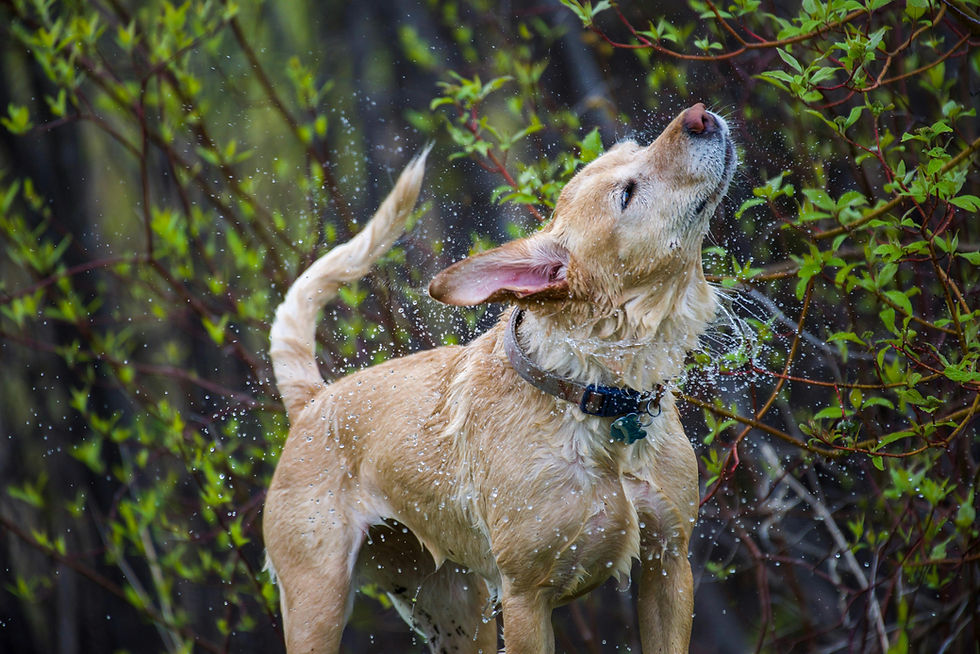
If you're still getting to know the breed, start here:
👉 LABRADOR GUIDE — Full Behaviour, Personality & Ownership Breakdown
Labrador personality: what people get wrong
People see a Labrador and think 'sensible family dog'. That's the destination. The journey there involves a great deal of bouncing, chewing and enthusiasm, and a dog who sometimes seems to have been assembled entirely from good intentions and appetite.
The other mistake is assuming every Labrador is the same. Owners are quick to correct that. Tia's owner, on Purina's owner stories, describes "Her big personality, she is loving and cuddly but can also be grumpy and fiesty especially when tired." Marley's owner, also on Purina, says simply: "He really is just one of a kind (I have had two other labs)". The breed has a type. Every dog also has opinions.
A note on the stories in this post: the dated moments (week one, month two and so on) are illustrative scenes based on common Labrador owner experiences, not the story of one real dog. The owner quotes are real, and link to where they were published.
The introduction
Week one. You take him to the park for the first time. He greets a toddler, two pensioners, a man with a newspaper, a Spaniel, another Spaniel and a pigeon, which declines. He comes back to you, sits on your foot, and looks up as if to ask why you don't know more people. You suspect he's going to be more popular than you round here.
Labrador personality traits at a glance
Trait | What it looks like at home | Where it comes from |
Friendly | Greets visitors like old friends | Bred to work in company, around people and other dogs |
Biddable | Learns fast, especially for food | Selected to take direction from a handler |
Food-driven | Knows the sound of every packet in the house | A strong appetite, and genes linked to hunger in some Labs |
Soft-mouthed | Carries shoes, toys and socks without damaging them | Bred to retrieve game gently |
Water-loving | Finds every puddle, pond and stream | Descended from dogs that worked with fishermen |
Slow to mature | Puppyish until two or three | An energetic working breed that grows into its brain late |
Owners recognise every line. The tail that clears the coffee table. The shoe brought to the door as a gift, slightly damp. The head that appears at the edge of the kitchen worktop the moment a packet rustles.
That warm, uncomplicated, slightly chaotic character is what Doggy Styles Inc designs around: clean, minimal Labrador pieces for people who live with a very large ray of sunshine and occasionally have to hoover up after it.
👉 Shop Labrador women's t-shirts, unisex t-shirts and sweatshirts and hoodies
👉 or explore the full LABRADOR COLLECTION

Where the Labrador personality comes from
From Newfoundland fishing boats
The Labrador's ancestors were working water dogs in Newfoundland, hauling nets and retrieving fish in icy water for the fishermen they lived with. Those dogs had to be tough, cooperative and happy in water, and to live closely alongside people. You can still see all three in a Labrador at the beach.
To British shooting estates
In the 1800s, dogs from Newfoundland were brought to Britain and developed by shooting estates into the retriever we know. The job was to sit quietly, watch where the bird fell, go when sent, and bring it back without a mark on it. That's where the biddable temperament, the steady patience and the famous soft mouth come from.
What the breed standard says
The Kennel Club breed standard sums up the result: "Good tempered, very agile", with an "Excellent nose, soft mouth; keen love of water. Adaptable, devoted companion." Owners would agree with every word. Some would add 'snack-focused' in the margin.
What the research says
The most useful research on Labrador personality comes from a study of 1,978 Labradors by Sarah Lofgren and colleagues at Scotland's Rural College and the University of Edinburgh, based on detailed owner questionnaires. Working status made more difference to personality than anything else they looked at. Labradors used as gundogs scored higher for 'fetching tendency' and 'trainability' than show dogs or pets. Coat colour showed smaller differences: owners rated chocolate Labradors as more excitable and more easily agitated when ignored than black Labradors, and lower for trainability and noise fear than both black and yellow (Lofgren and colleagues, Applied Animal Behaviour Science, 2014). These are owner ratings rather than direct observation, and the authors thought the differences were likely a mix of genetics and how the dogs were raised and trained.
There's an important footnote. In 2022, Kathleen Morrill and colleagues at the Broad Institute and UMass Chan Medical School combined owner surveys of more than 18,000 dogs with the DNA of over 2,000. Breed explained only about 9% of the variation in individual behaviour. Some traits, such as biddability and the urge to retrieve, were more strongly linked to breed than others, but the individual dog mattered far more than the label (Morrill and colleagues, Science, 2022). The Labrador type is real. Your Labrador is still allowed to be himself, and usually insists on it.
That people-focused breeding explains why so many Labradors are happiest within arm's reach of their owners.
👉 WHY ARE LABRADORS SO CLINGY? — Needy, Velcro or Anxious?
Why are Labradors so friendly?
It's the most searched question about the breed, and the answer is mostly breeding. A gundog has to work calmly alongside strangers, other dogs and other handlers on a shoot day, without fuss and without picking a fight. Generations of selection for that produced a dog with very little suspicion in him.
It's also learned. A Labrador puppy who meets lots of friendly people and gets a fuss from most of them grows up expecting the best of everyone. Labradors tend to get a lot of fuss. They have the kind of face that asks for it.
The only downside is that a Labrador's friendliness isn't always polite. Jumping up, leaning, and greeting every walker in the park as a personal friend are all friendliness, just not very well-mannered friendliness. That part is training.
The doorbell
Month two. The doorbell goes. He barks twice, then races to the door with his tail going so hard his whole back end swings. You open it. It's a delivery driver. He's delighted. The delivery driver, who has met Labradors before, holds the parcel above his head and waits for the welcome to pass.
How the Labrador personality changes with age
Puppy, eight weeks to six months. Curious, mouthy and into everything. Most of what goes into his mouth is an experiment.
Adolescent, six months to two years. Big, bouncy and selectively deaf. Labradors often seem to forget their training around this age, then remember it later. This is the stage when people give up on Labradors, and the stage when they most need patience.
Young adult, two to four years. The energy is still high, but the brain arrives. Many owners say their Labrador 'clicked' somewhere around two or three.
Adult, four to eight years. The Labrador people picture: steady, sociable, keen on walks and very keen on dinner.
Senior, eight onwards. Slower and more devoted. Still interested in food. Often more interested in a warm bed than a long walk, and in where his person is at all times.
A good start makes every one of those stages easier.
👉 HOW TO TRAIN A LABRADOR PUPPY — Calm, Reward-Based Foundations
Working-line or show-line Labrador: which personality suits you?
Labradors broadly come from two types of breeding. They're the same breed, but the differences matter when you're choosing a dog to live with.
Working (field) line | Show line | |
Build | Leaner, lighter, longer in the leg | Stockier, broader head, thicker tail |
Energy | Higher, needs more exercise and work | Generally calmer indoors |
Drive to retrieve | Very strong | Present, but usually less intense |
Trainability | Very responsive, needs a job | Responsive, easier-going |
Best for | Active owners, gundog work, dog sports | Family life, moderate activity |
Neither is better. A working-line Labrador in a quiet home without a job can be a handful. A show-line Labrador can be a little heavy and laid-back for a marathon runner. Ask a breeder what the parents do all day, and believe them.
The six Labrador personality types (you'll know yours)
Every Labrador is a mix, but most owners can spot one dominant setting.
The Retriever. Everything that can be carried will be carried. Sticks, socks, post, the cat's toy, occasionally the cat's dinner bowl. He greets you with something in his mouth and a look that says the delivery is complete.
The Gourmet. Can hear a cheese wrapper from two floors away. Has strong views on the timing of meals and considers 'later' a form of cruelty.
The Greeter. Believes every person in the park is a friend he hasn't met yet. Recall is excellent, unless there's a picnic.
The Water Baby. Measures walks by the number of ponds visited. Will find the one muddy ditch on an otherwise dry common, and lie in it.
The Shadow. Goes where you go. Lies where you lie. Sighs when you get up, then gets up too.
The Philosopher. Usually a senior, occasionally a show-line adult. Spends long periods lying in a sunny spot, considering things. Still the Gourmet, underneath.
Living with a Labrador's personality
Day to day, a Labrador is easy, cheerful company. Monty's owner on Purina's owner stories says what they love most is simple: "He's a kind soul." That's the Labrador at his best: gentle, uncomplicated and pleased to see you.
He also has his eccentricities. Mally's owner, on Purina, reports that "He also loves being hoovered!!" Many Labradors share an unusual tolerance for things other dogs find alarming, as long as attention is involved.
The other side is that a Labrador's enthusiasm doesn't always come with an off switch. A bored Lab chews. A frustrated Lab jumps up. A Lab who's learned that begging works will beg professionally.
A Labrador probably isn't the right fit if:
you want a calm, quiet dog from the start
you'd prefer a dog who's reserved with strangers
you'd rather not deal with a long, bouncy adolescence
you're not keen on a dog who considers every puddle an invitation
The visitor's handbag
Month four. A friend visits. He greets her, then quietly removes a glove from her handbag and carries it around the living room, very gently, tail high, as if presenting it at a ceremony. It comes back undamaged and only a little wet. Your friend is impressed by the soft mouth. You're more interested in how he opened the handbag.
That love of water is one of the most recognisable parts of the Labrador character, and it goes back to Newfoundland.
👉 WHY DO LABRADORS LOVE WATER SO MUCH? — Swimming, Instinct & Safety
Labrador body language: what he's really telling you
Labradors are expressive dogs, and most of what they say is cheerful. It's still worth knowing the quieter signals.
The whole-body wag. A low, wide wag that moves the back end and sometimes the whole dog is a happy, friendly Labrador. A high, stiff, fast tail is excitement or arousal, which isn't always the same thing.
The grin. Some Labradors pull their lips back in a wide, submissive 'smile' when greeting people they love. It looks alarming to strangers. It's affection, delivered with too many teeth.
The toy in the mouth. Many Labs grab something to carry when they're excited, especially when visitors arrive. It's a self-soothing habit and a very useful one. Encourage it.
The lean. Pressing his weight against your legs is a request for contact and reassurance. At 30 kilos, it's also quite hard to ignore.
The quiet signals. Yawning when he isn't tired, lip-licking, turning his head away or showing the whites of his eyes all mean he's uncomfortable. Labradors are tolerant dogs, which is exactly why these signals are easy to miss, especially around children.
The Labrador owner's dictionary
A short glossary for anyone new to the breed.
Starving: has eaten within the last hour.
Swim: any body of water, including puddles, ponds, the paddling pool and the dog bowl.
Gift: one shoe, slightly damp. The other is not part of the gift.
Recall: a suggestion, depending on the proximity of ducks.
Lean: affection, delivered at around 30 kilos.
Help: standing exactly where the fridge door needs to open.
Guarding: barking at the door, then welcoming whoever's behind it like a long-lost relative.
How to bring out the best in a Labrador's personality
The aim isn't to make a Labrador less of a Labrador. It's to give all that enthusiasm somewhere to go.
In the moment
Reward four paws on the floor when he greets people, before he gets the chance to jump.
Give him something to carry when visitors arrive. A toy in the mouth keeps the welcome gentle.
Ask for a sit before anything good happens: dinner, the lead, the door.
Long term
Give him a job. Retrieving games, scent hunts, carrying the post or a gundog class all use what a Labrador was bred for. A Lab with a job is calmer than a Lab without one.
Use his appetite, carefully. Food makes him one of the easiest dogs to train. Take training treats out of his daily allowance, because a Labrador's appetite will happily outpace his waistline.
Socialise him well. A Labrador who's met plenty of calm people, children and dogs grows into the easy-going adult the breed is known for.
Be patient with adolescence. Keep training short and positive through the teenage months. It's a phase. A long one, but a phase.
Choose the right line. If you're getting a puppy, match the breeding to your lifestyle, and ask about the parents' temperament as well as their health tests.
The steady dog
Month ten. A busy Saturday, with friends round and children everywhere. He greets everyone with a toy in his mouth, then lies down under the kitchen table, chin on a child's foot, and stays there all afternoon. Nobody asked him to. He simply decided that's where he was most useful.

When to get help: a sudden change in a Labrador's personality, such as irritability, reluctance to play or snapping when touched, is often a sign of pain, particularly in the joints or ears. See your vet first. For ongoing behaviour problems, ask for a referral to a qualified behaviourist.
Male or female Labrador: does it change the personality?
Less than people think. Male Labradors are usually larger and heavier, and some owners find them a little more boisterous and slower to mature. Females are often described as a touch more independent. But the research on sex differences in dog personality is mixed, and the differences between individual dogs, and between working and show lines, are much bigger than the differences between boys and girls.
Neutering doesn't reliably change a Labrador's personality either, though it does tend to reduce how many calories he needs. In this breed, that matters more than most.
Is a Labrador a good first dog?
Often, yes. A Labrador forgives mistakes, learns quickly and rarely holds a grudge. What catches first-time owners out isn't temperament. It's the sheer volume of everything: the exercise, the hair, the appetite and the length of adolescence. If you're ready for the volume, the personality will take care of most of the rest.
Labrador personality compared with other breeds
Compared with a Golden Retriever, a Labrador is usually a little more robust and less sensitive, and even more food-driven. Compared with a Border Collie, he's far less intense and much happier with an ordinary family routine. Compared with a Dachshund or a terrier, he has almost no interest in arguing with anyone. The Labrador's personality is, above all, agreeable. It's one of the reasons he's been one of the UK's most popular breeds for so long.
That agreeable nature is why so many families choose a Labrador, and why it usually works out.
👉 ARE LABRADORS GOOD FAMILY DOGS? — Children, Energy & Everyday Life
Of all his traits, the appetite is probably the one that shapes daily life the most.
👉 WHY ARE LABRADORS ALWAYS HUNGRY? — The Science Behind the Appetite
What Labrador owners realise over time
Most owners find the Labrador personality is exactly as advertised, just louder, hairier and hungrier. Once the bounciness settles, what's left is a dog who's kind, sociable and quietly devoted.
The introduction, a year on
A year after that first trip to the park. You take him again. He greets the toddler, the pensioners and the man with the newspaper, then comes straight back to you without being called and walks at your side. He still likes everyone. He's just worked out who he belongs to.
The verdict
The Labrador personality is friendly, biddable, food-driven and full of energy, shaped by generations of working closely with people on boats and shooting estates. Working-line Labs tend to be busier; show-line Labs calmer. Most take two or three years to grow up.
Give a Labrador a job, plenty of exercise, sensible food rules and some patience through adolescence, and you'll have one of the kindest, easiest-going companions there is.
If you're still getting to know the breed, the guide covers the full picture.
Living with a Labrador means sharing your life with a dog who's pleased to see absolutely everyone, and especially you. The Labrador range is for people who wouldn't have it any other way.
👉 Explore Labrador women's t-shirts, unisex t-shirts and sweatshirts and hoodies
👉 or explore the full LABRADOR COLLECTION
Got a Labrador with more personality than the breed standard allows for? Show us. Tag @doggystylesinc on Instagram or find us on Facebook at Doggy Styles Inc, and your Labrador could feature in a future post.
Continue Understanding the Labrador Breed
FAQs
What is a Labrador's personality like?
Friendly, eager to please, food-driven and energetic. Labradors are sociable with most people and dogs, love water and carrying things, and often stay puppyish until two or three.
Why are Labradors so friendly?
They were bred to work calmly alongside people and other dogs, and most are well socialised. Very little suspicion was ever bred into them.
What are the main Labrador personality traits?
Friendliness, trainability, a strong appetite, a soft mouth, a love of water and lots of energy.
What is the Labrador temperament according to the breed standard?
The Kennel Club describes it as intelligent, keen and biddable, with a strong will to please, and a kindly nature with no trace of aggression or undue shyness.
Are working Labradors different from show Labradors?
Yes. Working-line Labs tend to be leaner, more energetic and keener to retrieve. Show-line Labs are usually stockier and calmer at home.
Do chocolate Labradors have a different personality?
One large study found owners rated chocolate Labs as more excitable and slightly less trainable than black Labs, but individual dogs vary a great deal.
When do Labradors calm down?
Many settle noticeably between two and three years old, with good exercise and training. Some stay lively for longer.
Why are Labs always happy?
They're sociable, easy-going dogs who were bred to enjoy company and work. A well-exercised Lab with plenty of attention is usually a cheerful one.
Are Labradors good with strangers?
Most are very friendly with strangers, which makes them easy to live with but poor guard dogs.
Are Labradors intelligent?
Yes. They learn quickly, especially for food, which is why they're used so widely as guide, assistance and detection dogs.
Do Labradors have a soft mouth?
Yes. They were bred to retrieve game without damaging it, which is why many carry shoes, toys and socks so gently.
Can a Labrador's personality change?
Yes, with age and experience. A sudden change in temperament can also signal pain, so check with your vet.


Comments