


How Much Exercise Do Boxers Need? The Honest Truth Most Owners Only Fully Understand After Living With One

Updated: Oct 9
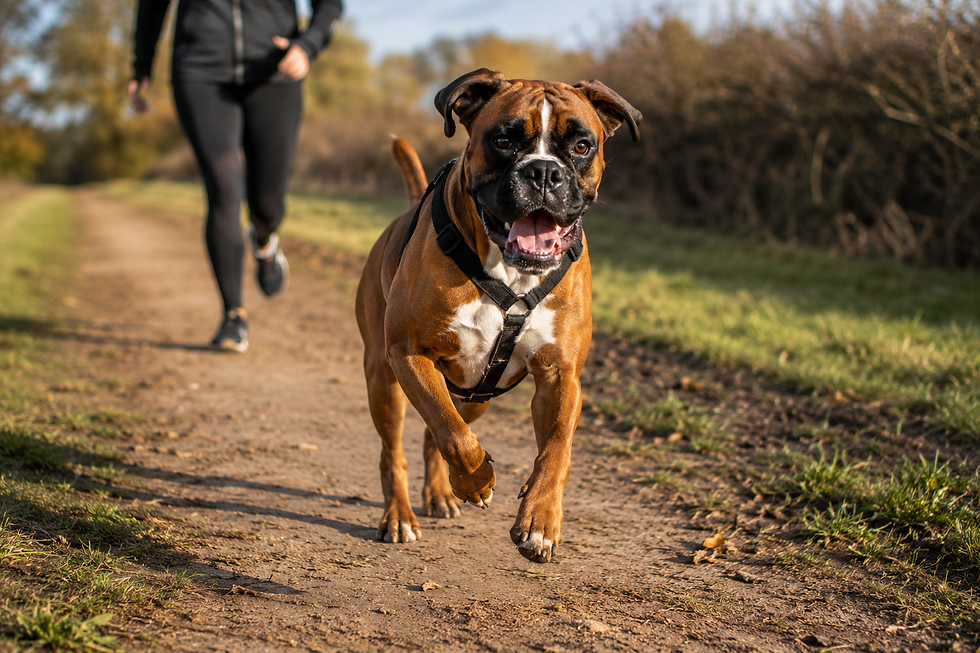
Quick Answer
Boxers need far more exercise than most people expect — but the real issue usually isn’t just physical exercise. It’s mental release. Emotional regulation. Structure. Stimulation. Routine.
A Boxer that only gets “walked” without properly releasing energy often becomes louder, more reactive, more demanding and harder to settle inside the house. What surprises many owners is that the behaviour problems usually don’t begin because the dog is aggressive.
They begin because the energy has nowhere meaningful to go. That’s the part most people misunderstand about the breed completely.
If you’re still understanding the breed properly, start here:
People often underestimate Boxer exercise needs because the breed can appear strangely calm at first. Especially indoors. Especially when resting. Then suddenly something switches. The dog explodes into movement, emotion and full physical commitment to absolutely everything happening around it.
One second asleep upside down on the sofa.The next flying at the front door like the house is under attack because someone closed a car door outside. That’s usually the point where owners realise they’re not dealing with a casually energetic breed.
They’re dealing with a dog that experiences life physically.
That same energy is exactly what Doggy Styles Inc builds around in its minimalist Boxer tote bags, t-shirts, sweatshirts and hoodies — clean, wearable designs inspired by the real ownership experience rather than novelty dog graphics or cartoon stereotypes.
Because Boxer owners usually recognise the breed instantly in the details: the chaos, the loyalty, the emotional intensity, the physical closeness and the feeling that the dog somehow becomes completely involved in every moment happening inside the house.
👉 Shop Boxer tote bags, women’s t-shirts, sweatshirts and hoodies
👉 or explore the full BOXER COLLECTION
The mistake most people make early
A lot of owners think Boxer exercise is mainly about tiring the dog out physically.
That usually works for about twenty minutes. Then the dog comes home still emotionally overstimulated, physically alert, and somehow even more reactive than before.
That’s because many Boxers don’t struggle with lack of movement.
They struggle with lack of release.

And that’s where the breed becomes difficult for people expecting a calmer or softer type of dog.
A Labrador often absorbs exercise gradually. A Golden Retriever usually softens emotionally once energy has been released properly. A Boxer often stays fully engaged long after the physical activity itself has ended.
Which means:
excitement carries forward
stimulation stacks
reactions speed up
settling becomes harder
That’s the point where many owners begin describing the dog as “too much” without fully understanding why. And honestly, most people don’t actually want a calm Boxer.
They just want a Boxer whose energy makes sense.
Exercise problems rarely look like exercise problems
This is where Boxer ownership becomes more nuanced than people expect.
Because insufficient exercise often appears indirectly instead.
The dog:
barks more
jumps more
reacts faster
struggles to settle
follows constantly
becomes emotionally demanding
overreacts to noise or movement
And because Boxers are so emotionally immediate, all of that behaviour tends to escalate quickly once overstimulation becomes routine.

What many owners eventually realise is that Boxer exercise and Boxer behaviour are almost impossible to separate from each other properly. The barking itself is usually only part of the issue. What’s really happening underneath is emotional momentum building too quickly, stimulation stacking too heavily, and the dog struggling to come back down once excitement fully takes over.
That’s also why experienced Boxer owners often stop trying to “wear the dog out” and instead start focusing on rhythm, consistency and emotional regulation instead.
Why Boxers become difficult without enough structure
The difficult part about the breed is that Boxers don’t usually self-regulate naturally when they’re younger. Excitement tends to build on top of excitement. Then momentum takes over. That’s why many Boxer behaviour problems happen during transitions:
greetings
visitors
walks
play
doors opening
stimulation spikes
A tired Boxer with poor emotional regulation can actually become harder to manage than an exercised Boxer with proper structure. That’s the part people rarely expect before living with the breed themselves. Especially because Boxers often look deceptively manageable during calmer moments.
Until suddenly they aren’t.
Living with a Boxer changes how you think about energy
Once you’ve lived with Boxers long enough, you start recognising that the breed’s energy isn’t random at all. It’s emotional. That’s why some Boxers can spend an hour asleep on the sofa, then suddenly launch themselves fully into life the second something changes in the environment.

That emotional responsiveness is also why people become so attached to the breed.
Because the same intensity that creates chaos also creates presence. They don’t half-participate in family life. They fully involve themselves in it.
They follow people room to room. They react emotionally to routines. They somehow manage to make even sitting quietly feel physically committed.
That emotional involvement is also why Boxer temperament feels very different once owners truly understand the breed beyond the “energetic clown dog” stereotype people often expect initially. Most experienced Boxer owners eventually realise the breed is far more emotionally layered — and far more sensitive to atmosphere — than people first assume.
Over-exercising can become a problem too
This is something people almost never talk about properly. Some owners accidentally create athletes instead of balanced dogs.
The more energy the Boxer shows, the more exercise gets added. Then the dog adapts physically, develops even higher stamina, and suddenly normal daily exercise no longer touches the emotional intensity at all.
The result is often:
physically exhausted owners
mentally overstimulated dogs
constant management
poor settling indoors
What many experienced Boxer owners eventually learn is that calmness has to be practised too. Not just activity.

That balance is usually what separates manageable Boxers froM overwhelming ones
And it’s often why Boxer ownership feels either incredibly rewarding or emotionally exhausting depending on how well the dog’s energy is understood early on. The people who thrive with Boxers are usually the people who stop trying to eliminate the energy completely and instead learn how to guide it properly. Because once the rhythm starts making sense, the chaos stops feeling chaotic in the same way.
It’s all connected
Once you understand the breed properly, almost everything starts linking back to stimulation and emotional regulation. The barking.The jumping.The destructiveness.The reactivity.The attachment.
Even the famous Boxer “mad moments” usually make far more sense once owners understand how quickly emotional momentum builds inside the breed.
That’s also why Boxers often thrive in households with:
routine
consistency
movement
structure
emotional engagement
Without those things, the same personality that feels funny and lovable at first can eventually start feeling exhausting. Most people don’t fully appreciate that until they’ve experienced daily life with the breed themselves.
That’s also why Boxers tend to work best in families that genuinely enjoy involvement from a dog rather than simply wanting calm companionship in the background.
The version people don’t expect
Because despite all of this, Boxer owners rarely want a calmer breed afterwards.
Not really. They complain about the chaos. The energy. The intensity. Then immediately describe the dog like a family member five minutes later.

That probably explains the breed better than anything else. Because once the rhythm of the breed starts making sense, the energy stops feeling like a problem and starts feeling more like personality expressed physically. Eventually owners stop asking: “How do I stop this energy?” And start asking: “How do I guide it properly?” That’s usually the point where Boxer ownership becomes much easier.
The hard truth
Boxers need significant exercise. But more importantly:they need meaningful release, emotional structure and consistent routine.
Without that, the breed can become overwhelming surprisingly quickly. With it, they become one of the most emotionally engaging dogs people ever own.
That connects directly to how well Boxers cope when they’re left alone.
Boxer Lifestyle
Living with a Boxer means movement, emotional intensity, attachment, unpredictability and a dog that somehow manages to feel both exhausting and completely lovable at exactly the same time. For the right person, that becomes the appeal.
That’s the energy behind the Boxer range — minimalist apparel designed around the real ownership experience rather than idealised dog stereotypes.
👉 Explore Boxer unisex t-shirts, sweatshirts and hoodies and tote bags
👉 or shop the full BOXER COLLECTION
Got a Boxer who does the full-body wiggle every time you walk in? Show us. Tag @doggystylesinc on Instagram or find us on Facebook at Doggy Styles Inc, and your dog could feature in a future post.
Final Verdict
Boxers need a lot of exercise. But more importantly, they need structure, emotional regulation and meaningful energy release alongside the physical activity itself.
That’s usually the difference between a balanced Boxer and an overwhelming one.
Final Thought
Most Boxer owners eventually realise the breed was never “too energetic.”
The energy just needed direction.
Continue Understanding the Boxer Breed
If you’re still understanding how Boxer behaviour and ownership actually work in real life, these articles connect most closely to the patterns above:
FAQ — Boxer Exercise & Energy Levels
How much exercise do Boxers need daily?
Most adult Boxers need at least 1–2 hours of meaningful daily exercise alongside mental stimulation and structure.
Are Boxers high-energy dogs?
Yes. Boxers are highly energetic, emotionally responsive dogs that usually need far more engagement than people initially expect.
What happens if a Boxer doesn’t get enough exercise?
Insufficient exercise often leads to barking, jumping, overstimulation, destructiveness and difficulty settling indoors.
Can you over-exercise a Boxer?
Yes. Some owners accidentally build extreme stamina without teaching calmness or emotional regulation.
Do Boxers calm down with age?
Most Boxers become calmer as they mature, although structure and routine usually matter more than age alone.
Are Boxers difficult to tire out?
Physically, yes — but emotional release and structure are often more important than simply adding more exercise.
Why is my Boxer still hyper after walks?
Many Boxers remain emotionally stimulated long after physical exercise ends, especially if excitement levels stayed high during activity.
Do Boxers need mental stimulation too?
Absolutely. Training, structure and engagement are essential for preventing overstimulation and behavioural problems.
Are Boxers good running dogs?
Many healthy adult Boxers enjoy running and active lifestyles, although exercise should be balanced carefully with recovery and calmness.
Do Boxers need a garden?
Not necessarily, but they do need consistent exercise, structure and stimulation every day.
Are Boxers good apartment dogs?
They can be if properly exercised and mentally balanced, although under-stimulated Boxers often struggle in confined environments.
Why are Boxers so energetic?
The breed was developed to be athletic, alert, emotionally engaged and physically responsive, which creates the intensity owners recognise.


Comments